




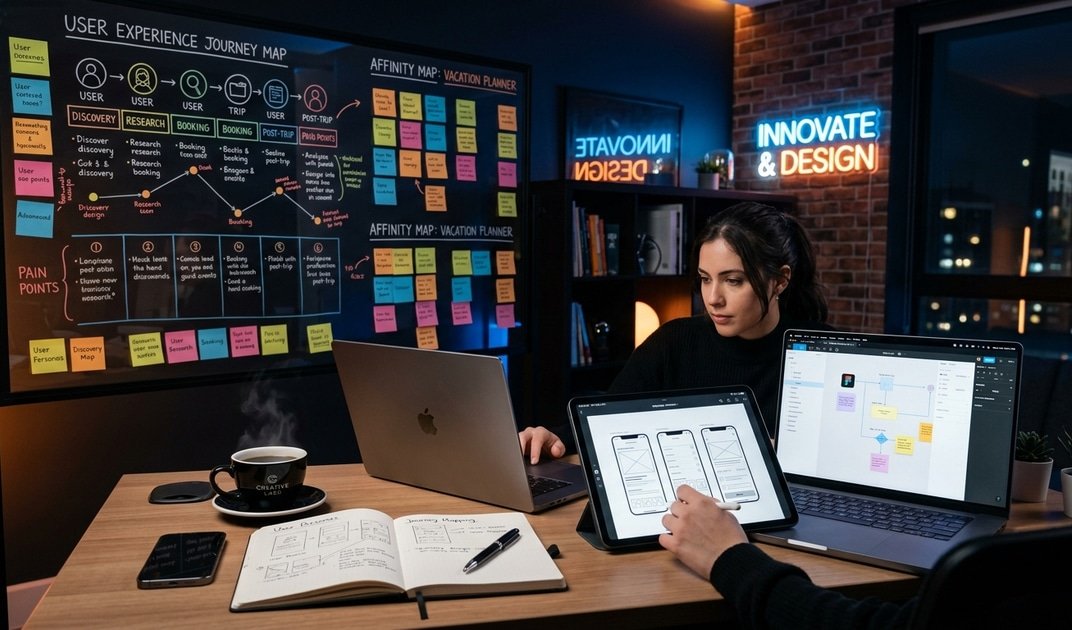
The most dangerous phrase in digital product development is "Our users definitely want this feature." Building without continuous qualitative research leads to feature bloat, confusing navigation, and expensive rework. Here is how Ondigma's design lab uncovers true customer motivations before writing a single line of code.
While web analytics dashboards reveal what actions users take on your digital platforms, they never explain why users hesitate, abandon, or churn. Qualitative user research bridges this gap, giving product owners and engineers an empathetic lens into the actual mental models of real humans.
Strategic Takeaways for Product Teams
- The "Rule of 5": Just 5 user testing sessions will reveal approximately 85% of usability issues on a core workflow.
- Jobs-to-be-Done (JTBD): Focus on the underlying progress a user is trying to make rather than demographic personas.
- Behavior Over Opinion: Observe what users do in realistic prototype scenarios rather than asking what they hypothetically like.
- Fast Synthesis: Convert qualitative observations into actionable affinity themes within 24 hours of session completion.
1. The Real Cost of Building on Assumptions
Every unvalidated assumption carried into engineering sprints incurs an exponential compounding cost. Fixing a flawed concept during the wireframing stage takes hours; fixing it after high-fidelity design takes days; fixing it after full-stack implementation and production deployment takes weeks of architectural rewrites.
When teams replace gut feeling with structured user research, they eliminate unnecessary features from the product roadmap, cutting development time by an average of 35% while increasing user adoption upon launch.
“User research isn't about validating your preconceived design ideas; it is about relentlessly falling in love with your users' actual problems.”
— Lead UX Researcher, Ondigma Infotech
2. Generative User Interviews & Jobs-to-be-Done (JTBD)
A generative interview is designed to uncover how people think and live, rather than evaluating an existing prototype. The most effective interviewers ask open-ended, non-leading questions that prompt specific behavioral stories rather than generalized generalizations.
- Avoid: "Would you use an automated reporting dashboard?" (Generates false positive polite responses).
- Ask Instead: "Walk me through the exact steps you took the last time you prepared an executive performance report."
- Ask Instead: "What was the most frustrating part of that process? What workarounds did you use?"
3. Usability Severity Rating Matrix
When testing workflows, how do you categorize and prioritize feedback? We utilize this standardized 4-tier severity matrix across all client digital audits:
| Severity Level | User Impact Description | Frequency Across Cohort | Resolution SLA |
|---|---|---|---|
| Critical (Level 1) | User is completely blocked from completing the primary task (e.g. broken payment button). | > 20% of participants | Immediate Hotfix (< 24h) |
| High (Level 2) | Significant friction or confusion; user completes task only after multiple failed attempts. | > 40% of participants | Current Sprint Priority |
| Medium (Level 3) | Minor hesitation; visual distraction or ambiguous terminology that slows down flow. | 20% - 50% of participants | Next Planned Sprint |
| Low (Level 4) | Cosmetic inconsistency or slight typographic misalignment with zero impact on task completion. | Any occurrence | Backlog / Polish Cycle |
4. Telemetry & Friction Signal Detection
In addition to in-person user lab sessions, modern UX engineering relies on automated telemetry scripts that flag behavioral friction signals in production. By detecting "rage clicks" and repeated dead taps, designers can pinpoint broken experiences instantaneously.
// Ondigma UX Telemetry: Capturing Rage Clicks & Hesitation
let clickHistory = [];
document.addEventListener('click', (event) => {
  const now = Date.now();
  clickHistory.push({ target: event.target, timestamp: now });

  // Filter clicks within the last 1000ms on identical container
  const recentClicks = clickHistory.filter(c => now - c.timestamp < 1000);
  if (recentClicks.length >= 3) {
    window.ondigmaUX.recordFriction({
      type: 'rage_click',
      element: event.target.tagName,
      selector: event.target.className,
      pageUrl: window.location.pathname,
      severity: 'high'
    });
    clickHistory = [];
  }
});
5. Embedding Discovery in Agile Sprints
Research is not a one-time phase at the beginning of a redesign project; it must be an ongoing heartbeat. At Ondigma Infotech, we integrate bi-weekly "Discovery Thursdays" where designers and engineers review 3 fresh user recordings together, maintaining sharp empathy throughout the product lifecycle.

Discussion (4 Contributions)
Aarav Sharma
Spot on breakdown. We implemented this exact framework in our recent sprint and immediately noticed measurable reductions in drop-off rates.
Leave a Contribution
Your email address will not be published. Required fields are marked with *